Perfect TV Height Calculator
Calculate the ideal mounting height for your 65-inch TV based on your seated eye level.
Recommended Placement
Center of Screen:
-- inches
Bottom of Screen:
-- inches
Why this works:
Aligning the center of the screen with your eyes reduces neck strain and provides a natural viewing angle.
You’ve just unboxed your shiny new 65-inch TV is a large-screen television with a diagonal measurement of 65 inches, offering an immersive viewing experience for movies and gaming. It’s massive. It’s impressive. But now you’re staring at a blank wall or a piece of furniture, wondering: where exactly does this thing go? Mount it too high, and you’ll look like you’re attending a yoga class while watching Netflix. Place it too low, and you’ll be hunching over like a detective inspecting a crime scene.
The short answer? Your eyes should be level with the center of the screen when you are sitting down comfortably. For most people, that puts the center of a 65-inch TV between 42 and 48 inches from the floor. But getting there requires a bit more math than just guessing. Let’s break down how to find your perfect spot so your neck stays happy and your view stays clear.
The Golden Rule: Eye Level Is Everything
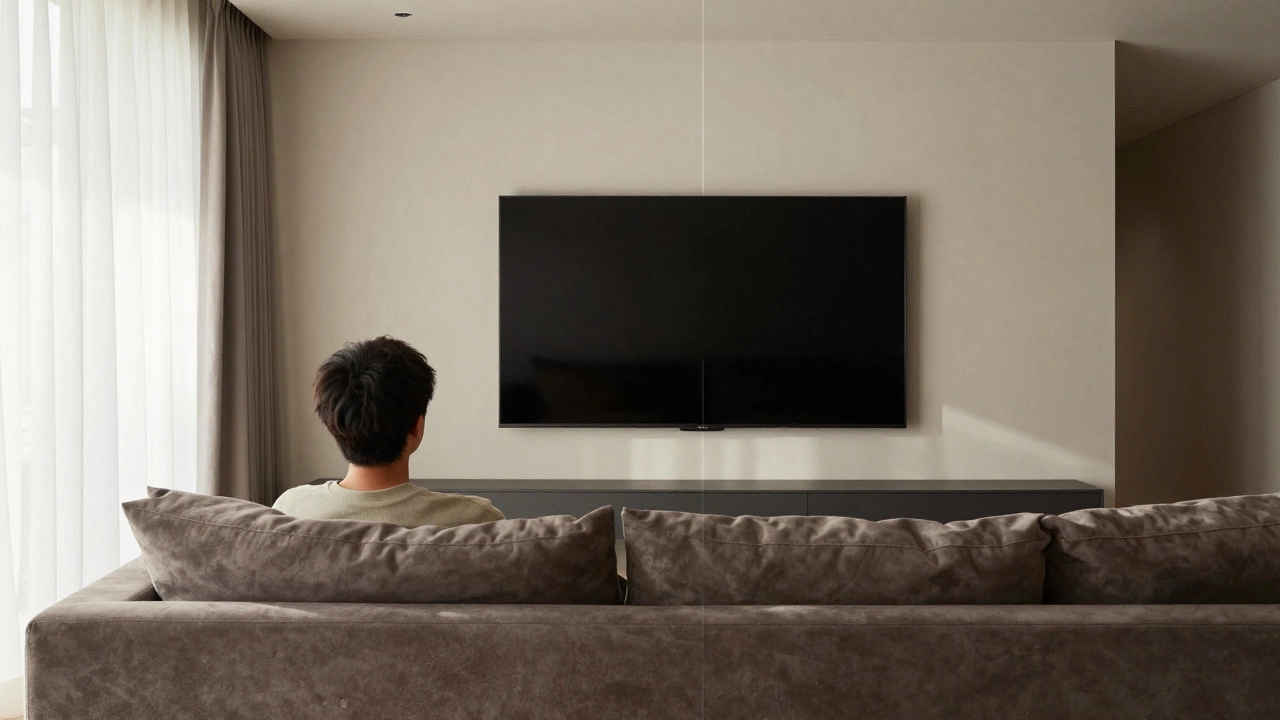
We spend hours on our couches. If your posture suffers because of bad TV placement, no amount of 4K resolution will save you. The core principle of ergonomic TV viewing is positioning a television screen so that the viewer's eyes align with the center of the display, reducing strain on the neck and back is simple: neutral spine alignment. When you sit, your head shouldn’t tilt up or down significantly.
Here is the problem with big screens: they are tall. A 65-inch TV isn’t just wide; it has significant vertical height. If you mount the top of the TV at eye level, you’re looking at the bottom bezel, not the action. You need to measure from the floor to your eyes, then subtract half the height of the TV. That gives you the ideal height for the *center* of the screen.
- Average seated eye height: About 36 to 40 inches from the floor for an average adult.
- Height of a 65-inch TV: Approximately 33 inches (excluding stand).
- Half-height adjustment: Subtract 16.5 inches from your eye level.
- Result: The center of the TV should be around 20-24 inches above your seated eye line? No, wait. Let’s re-calculate. If your eyes are at 40 inches, and the center of the TV needs to be at 40 inches, then the center is at 40 inches. The bottom of the TV would be at 40 - 16.5 = 23.5 inches off the floor.
Wait, that sounds low. And it is. That’s why we often aim slightly higher for comfort, especially if you have kids who crawl around or pets that jump up. Most interior designers and ergonomists suggest aiming for the center of the TV to be between 42 and 48 inches from the floor. This accounts for slight variations in chair height and personal preference.
Calculating the Exact Height for Your Space
Every living room is different. You might have a deep-plush sofa that sinks you lower, or a firm dining chair that sits you higher. To get the precise number, grab a tape measure and do this quick test:
- Sit in your primary viewing seat as you normally would-relaxed, feet flat on the floor.
- Ask someone to mark the wall at the exact height of your pupils. Use a pencil or a sticky note.
- Measure from the floor to that mark. Let’s say it’s 42 inches.
- Divide the height of your 65-inch TV by two. A standard 65-inch panel is about 33 inches tall, so half is 16.5 inches.
- Subtract 16.5 from 42. The result is 25.5 inches.
This means the bottom of your TV should be 25.5 inches off the floor. The center will be at 42 inches, perfectly aligned with your eyes. Simple, right? But here is where things get tricky. Are you mounting it directly to the wall? Or putting it on a stand?
Wall-Mounted vs. TV Stand: What’s the Difference?
If you are using a wall mount is a hardware bracket used to attach a television directly to a wall, saving space and allowing for precise height adjustment, you have total control. You can drill holes at exactly 25.5 inches from the floor for the bottom edge. However, if you are using a TV stand is a piece of furniture designed to hold a television, providing storage and stability without requiring wall installation, you are limited by the furniture’s design.
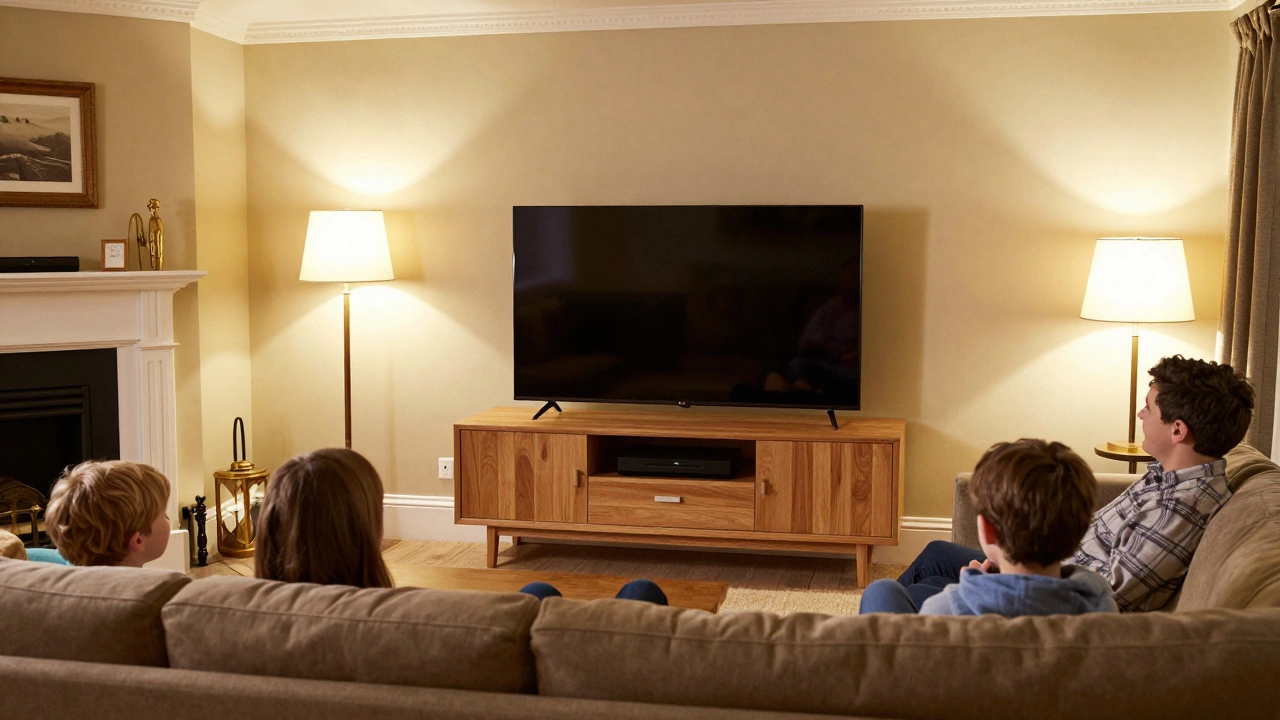
Most standard TV stands for 65-inch models are between 20 and 24 inches tall. If your stand is 22 inches tall, the bottom of your TV sits at 22 inches. The center of the TV is then at 22 + 16.5 = 38.5 inches. If your seated eye level is 42 inches, you’ll be looking down slightly. Is that bad? Not necessarily. Looking down is generally easier on the neck than looking up. Many people prefer a slightly lower angle because it feels more natural, similar to reading a book.
| Placement Type | Typical Bottom Height | Center Screen Height | Best For |
|---|---|---|---|
| Wall Mount (Ergonomic) | 24-26 inches | 40-42 inches | Precise eye-level alignment |
| Standard TV Stand | 20-24 inches | 36-40 inches | Flexibility and storage needs |
| Entertainment Center | 18-22 inches | 34-38 inches | Traditional living rooms |
If your stand is too tall, you have a problem. Some modern media consoles are sleek and low, but others are bulky. If your stand is 30 inches tall, your TV center is at 46.5 inches. If your eyes are at 42 inches, you’re craning your neck up. Over time, this causes tension headaches. In this case, consider a lower-profile stand or raising your seating with thicker cushions.
Viewing Distance Matters Too
Height isn’t the only factor. How far away are you sitting? For a 65-inch TV, the recommended viewing distance is the optimal distance between the viewer and the TV screen to ensure comfortable viewing without eye strain or loss of detail is between 6.5 and 9 feet (roughly 2 to 2.7 meters). If you sit closer than 6 feet, the screen might feel overwhelming, and you might notice pixelation if the resolution isn’t perfect. If you sit further than 10 feet, the image loses impact, and you might miss subtle details.
Why does distance affect height? Because perspective changes. If you are sitting very close, even a small deviation in height becomes noticeable. If you are across the room, your eyes adjust more easily. So, if you have a large open-plan living room and you watch from the other side of the house, you can afford to be less precise with the height. But if you have a cozy den setup, nail that eye-level calculation.
Special Scenarios: Bedrooms and Kitchens
Not all TVs live in the living room. Maybe you’re installing a 65-inch screen in the bedroom. Here, the rules shift slightly. In bed, you are lying down or propped up with pillows. Your eye level is much lower relative to the floor. If you mount the TV at standard living room height, you’ll be staring at the ceiling.
For bedrooms, aim for the center of the TV to be level with your eyes when you are in your typical sleeping position. If you sleep propped up on one pillow, that might be 30-35 inches from the floor. If you use a full-size pillow, maybe 40 inches. Measure accordingly. Also, consider glare. Bedside lamps can reflect off the screen, so avoid placing the TV opposite bright windows or lights.
In kitchens, 65-inch TVs are rare but growing in popularity for open-concept homes. Here, you’re likely standing or sitting on a bar stool. Standing eye level is about 55-60 inches from the floor. So, the center of the TV should be around 55 inches. That means the bottom of the TV is at 55 - 16.5 = 38.5 inches. This is significantly higher than a living room setup. Don’t try to fit a kitchen TV into a living room height formula.
Avoiding Common Mistakes
I see this mistake all the time: people mount their TV high up because they think it looks "cleaner" or matches the artwork on the wall. Artwork is hung at eye level when standing, which is about 57-60 inches from the floor. TVs are not art. They are functional devices. Hanging a TV at 60 inches center height forces you to look up. After two hours of movie night, your neck will thank you if you didn’t do that.
Another common error is ignoring the TV stand’s depth. A 65-inch TV is heavy and top-heavy. If you put it on a narrow stand, it might wobble. Ensure the stand is wide enough to support the base of the TV securely. Most 65-inch TVs require a stand width of at least 40 inches for stability.
Also, don’t forget about cable management. If you mount the TV, run cables through the wall if possible. Exposed wires dangling down to a console below look messy and distract from the clean aesthetic you’re trying to achieve. Use in-wall cable kits available at most hardware stores.
Final Check: Test Before You Drill
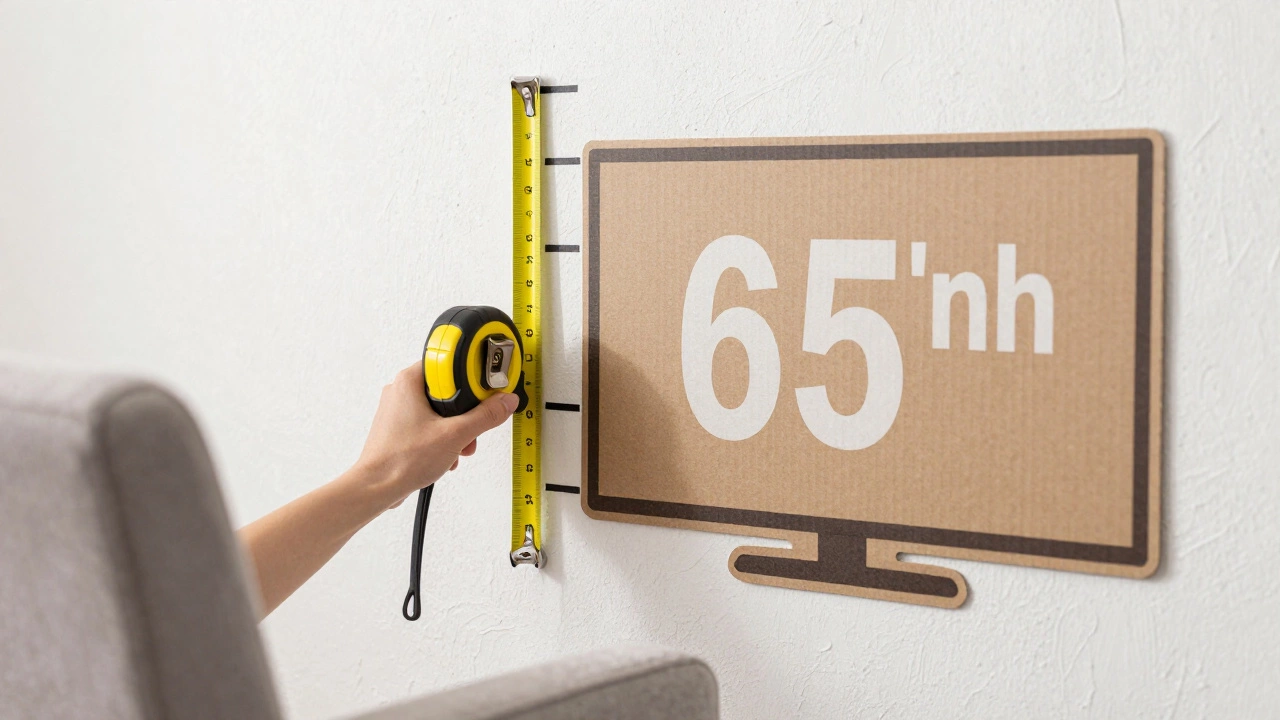
Before you commit to drilling holes or buying a new stand, do a mock-up. Cut out a rectangle of cardboard the size of your 65-inch TV (approx. 57 inches wide by 33 inches tall). Tape it to the wall at your calculated height. Sit down. Watch a video for 10 minutes. Does your neck feel okay? Do you feel immersed? If yes, you’ve got it. If no, adjust the height by an inch or two and try again. It’s easier to move cardboard than to patch drywall.
Getting the height right transforms your viewing experience. It’s not just about aesthetics; it’s about comfort and health. Take the time to measure, calculate, and test. Your eyes-and your neck-will appreciate it.
What is the ideal height for a 65-inch TV on a wall?
The ideal height for a 65-inch TV on a wall is such that the center of the screen is level with your eyes when seated. For most people, this means the center of the TV should be between 42 and 48 inches from the floor. This places the bottom of the TV approximately 24 to 30 inches off the ground.
Should I mount my TV higher if I have kids?
Yes, if you have young children who might climb on furniture or pull things down, it’s safer to mount the TV slightly higher. However, try not to exceed a center height of 50 inches to avoid neck strain. Consider using a safety strap or anti-tip kit for added security.
How far should I sit from a 65-inch TV?
For a 65-inch TV, the recommended viewing distance is between 6.5 and 9 feet (2 to 2.7 meters). This range ensures you can appreciate the detail of 4K resolution without feeling overwhelmed by the screen size.
Can I place a 65-inch TV on a regular TV stand?
Yes, but ensure the stand is wide enough (at least 40 inches) and sturdy enough to support the weight. Check the stand’s height; if it’s too tall, the TV may be positioned too high for comfortable viewing. Measure the stand’s height and add half the TV’s height to determine the center screen level.
Is it better to look up or down at a TV?
It is generally better to look slightly down or straight ahead at a TV. Looking up strains the neck muscles more than looking down. If your TV is slightly too low, it’s usually more comfortable than if it’s too high. Aim for eye-level alignment for the best ergonomic outcome.