Recliner Safety Assessment
Assess if your recliner usage is safe for your spine. Based on research from the Journal of Orthopaedic & Sports Physical Therapy and University of Leeds studies.
Recommendations
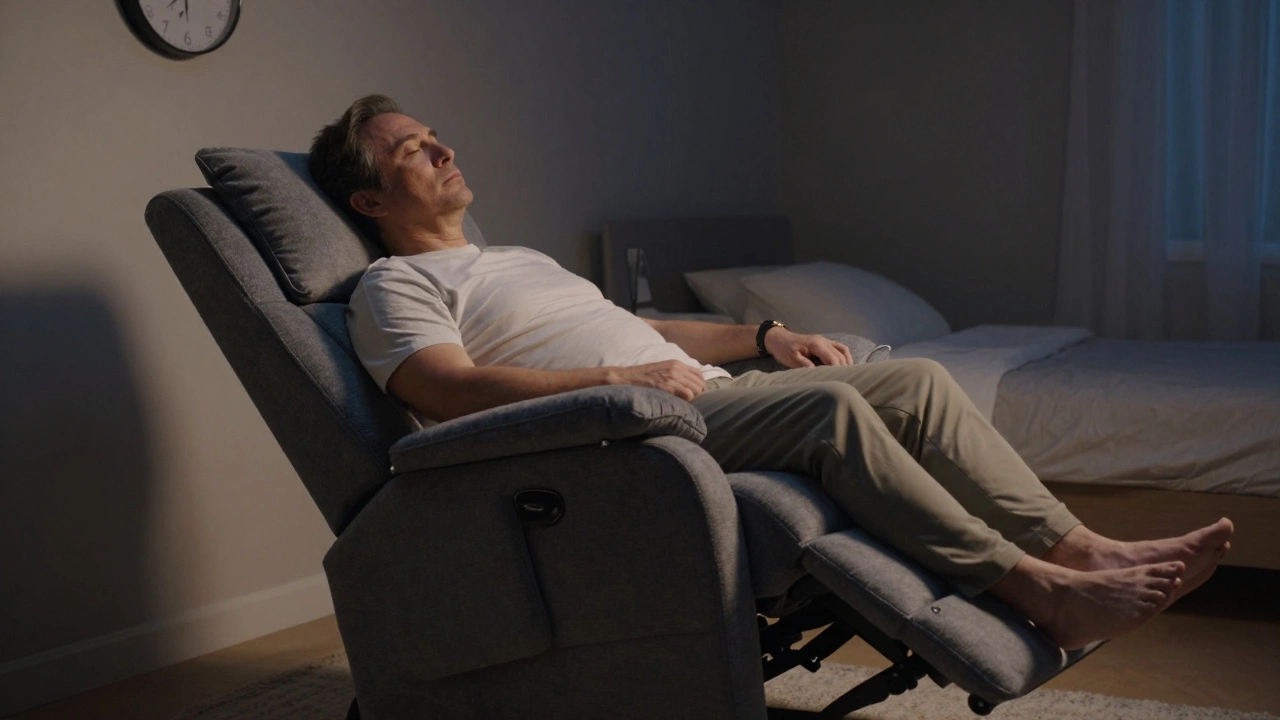
Many people swear by sleeping in a recliner-whether it’s because of snoring, acid reflux, or just plain comfort. But if you’ve woken up with a stiff lower back or a nagging ache after a night in your favorite chair, you’re not alone. The question isn’t just whether it’s comfortable-it’s whether it’s safe for your spine over time.
Why People Sleep in Recliners
It’s not just about laziness. People with chronic back pain, sleep apnea, or GERD often find relief in a reclined position. Elevating the head reduces pressure on the esophagus, which helps with heartburn. For those with spinal stenosis or sciatica, the slight forward tilt of a recliner can take pressure off pinched nerves. A 2023 study from the Journal of Orthopaedic & Sports Physical Therapy found that 68% of participants with chronic lower back pain reported better sleep quality in a recliner than in a flat bed.
But comfort doesn’t equal long-term health. Just because you fall asleep easily doesn’t mean your spine is getting the support it needs.
How Recliners Affect Your Spine
Your spine has three natural curves: cervical (neck), thoracic (mid-back), and lumbar (lower back). When you lie flat, these curves are supported by a good mattress. In a recliner, things change.
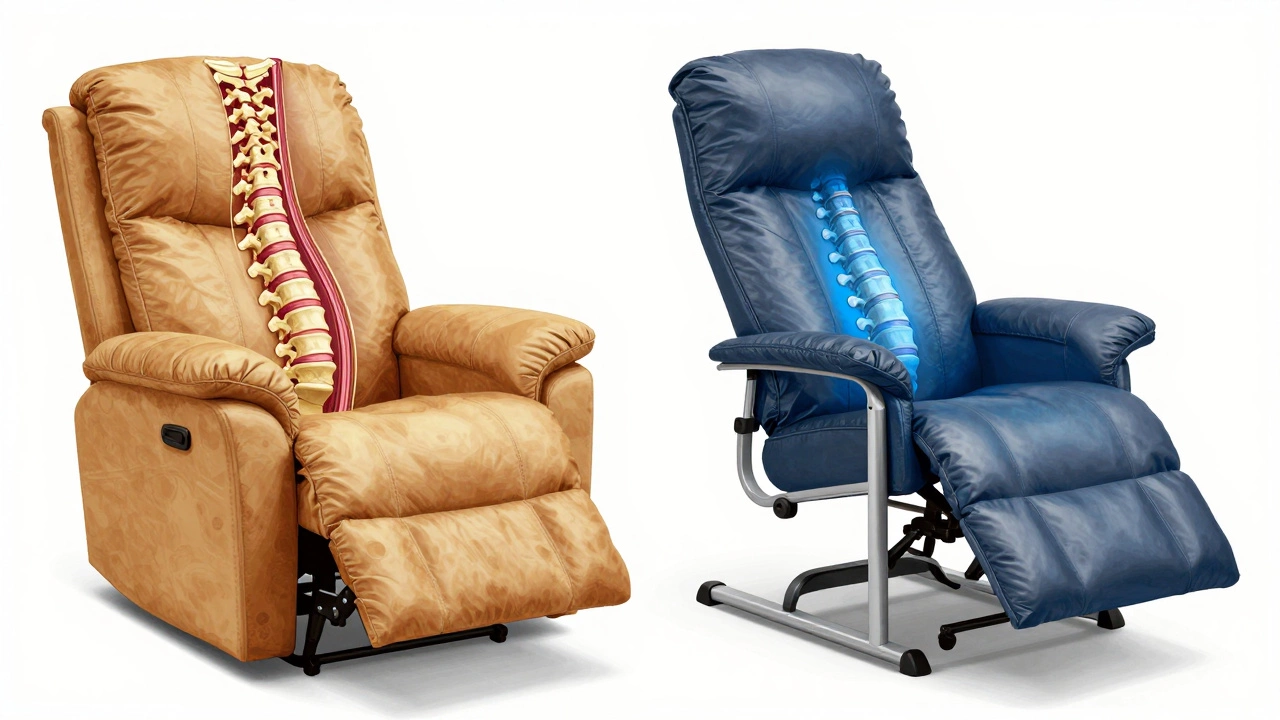
Most recliners lack proper lumbar support. The seat is often too shallow, so your pelvis tilts backward, flattening the natural curve in your lower back. That puts extra strain on the discs and ligaments. Over time, this can lead to muscle imbalances, disc degeneration, or even herniated discs.
Also, many people sleep in recliners with their legs extended straight out. That position tightens the hamstrings and pulls on the pelvis, making it harder for your lower back to stay aligned. It’s like trying to sleep with a rubber band stretched between your hips and knees.
What the Research Says
A 2022 analysis of 1,200 adults who regularly slept in recliners found that 43% developed new or worsening lower back pain within six months. The risk doubled for those who slept in the chair five or more nights a week. The study didn’t find a direct link to spinal damage in healthy people, but it did show that people with existing back issues were far more likely to see symptoms get worse.
On the flip side, a small 2024 trial from the University of Leeds tested 30 patients with degenerative disc disease who switched to sleeping in a zero-gravity recliner (a type with adjustable leg and back support). After eight weeks, 72% reported less pain and better sleep. The key difference? These chairs mimicked the neutral spine position used in physical therapy.
Not All Recliners Are Created Equal
There’s a big difference between a basic recliner you bought at a discount store and a medical-grade zero-gravity chair. Here’s what to look for:
- Lumbar support: The chair should curve inward at the lower back, not just slope backward.
- Adjustable footrest: Your knees should be slightly higher than your hips, not level or lower.
- Seat depth: There should be 2-3 inches of space between the edge of the seat and the back of your knees.
- Recline angle: Between 110 and 130 degrees is ideal. Anything flatter than 110 puts pressure on the spine; anything steeper than 130 can strain your neck.
Brands like La-Z-Boy’s Motion Essentials line, Human Touch’s Novo, and even some high-end IKEA models have these features. Avoid cheap plastic-framed recliners with foam that collapses after a few months.
Who Should Avoid Sleeping in a Recliner
Not everyone should try this. If you have any of these conditions, sleeping in a recliner could do more harm than good:
- Severe osteoporosis-your bones can’t handle uneven pressure
- Advanced scoliosis-recliners often worsen spinal rotation
- Recent spinal surgery-your doctor will tell you to stay flat
- Chronic hip or knee arthritis-recliner positions can lock joints in painful angles
If you’re unsure, talk to a physical therapist. They can assess your posture in a recliner and suggest modifications-or warn you off entirely.
How to Sleep in a Recliner Without Hurting Your Back
If you’re going to sleep in a recliner, do it right. Here’s how:
- Use a small pillow behind your lower back-roll up a towel if you don’t have one. This restores the natural curve.
- Keep your knees slightly bent-place a pillow under your calves if the footrest doesn’t let you bend naturally.
- Don’t slouch-sit up straight, shoulders relaxed. If your head tilts forward, add a neck pillow.
- Limit it to occasional use-no more than 2-3 nights a week. Use it as a temporary fix, not a permanent bed.
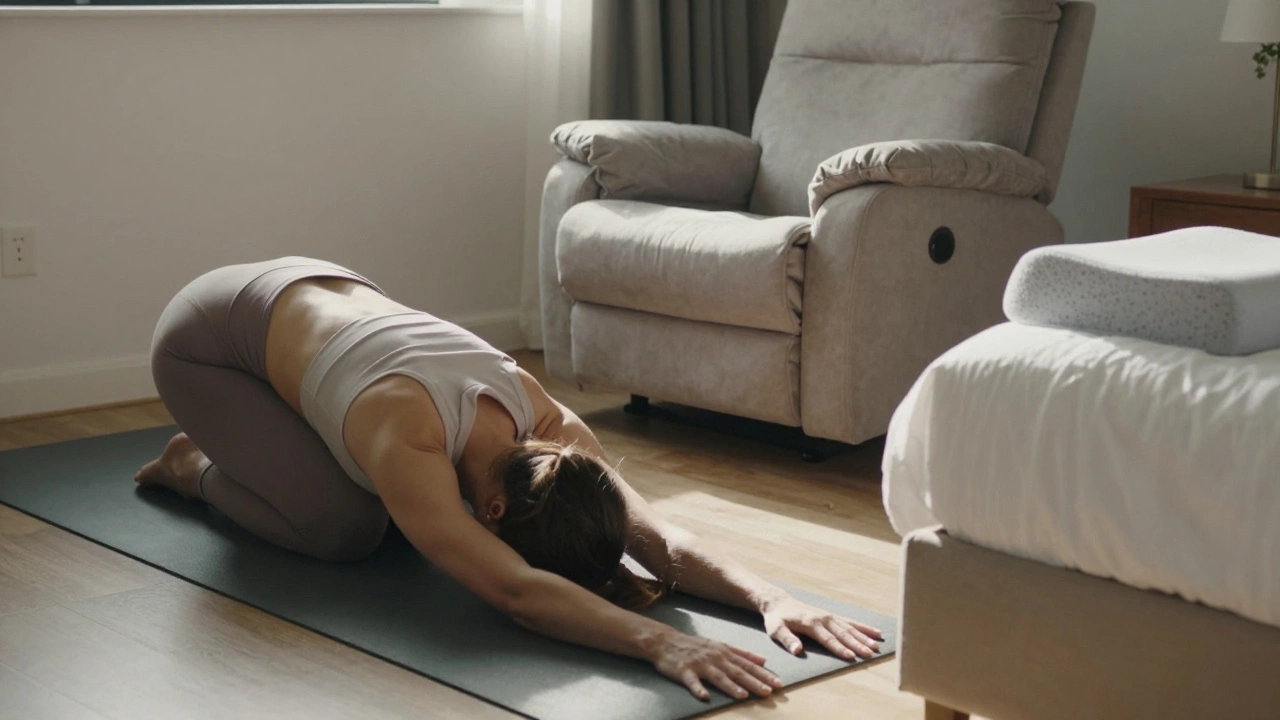
- Stretch in the morning-do 5 minutes of cat-cow stretches and pelvic tilts to reset your spine.
Some people use recliners as a bridge-sleeping in them while recovering from an injury, then slowly transitioning back to a bed. That’s smart. Staying in one forever? Not so much.
Alternatives to Consider
If you’re sleeping in a recliner because your bed hurts, fix the real problem.
- Memory foam mattress topper: Adds contouring support without replacing your whole bed.
- Adjustable bed base: Lets you elevate your head and knees like a zero-gravity chair, but with full spine support.
- Wedge pillow: A 6-inch foam wedge under your upper body helps with reflux and breathing without the chair’s posture traps.
These options cost less than a high-end recliner and are far better for your spine long-term.
When to See a Doctor
If you’ve been sleeping in a recliner for more than three months and you’re noticing:
- Morning stiffness that lasts more than 30 minutes
- Pain that radiates down your leg
- Numbness or tingling in your feet
- Difficulty standing up straight after sitting
It’s time to get checked. These aren’t just "bad nights"-they’re signs your spine is adapting to poor alignment. Left unchecked, that can lead to permanent changes.
Most cases improve with physical therapy and posture correction. But you need to catch them early.