Ergonomic Posture & Chair Assessment Tool
Current Setup Checklist
Answer these questions about your current seating situation to evaluate your risk for slouching.
Your Posture Health Score
Complete the checklist and click calculate to see your personalized feedback and recommendations.
Is Your Posture Permanently Broken?
You’ve probably heard it before: "Sit up straight." Maybe a teacher told you that in third grade, or maybe your mom nagged you about it while you were glued to the TV. Now, as an adult spending eight hours a day at a desk, you’re wondering if all that slouching has permanently warped your spine. The short answer is no. Slouching posture is a habitual misalignment of the spine caused by poor seating habits and muscle weakness, not a permanent structural defect. In most cases, your body is incredibly adaptable. If you change the inputs-how you sit, what you sit on, and how you move-the outputs will follow.
However, fixing this isn’t just about willpower. It’s about mechanics. You can’t out-discipline a bad chair. If your ergonomic seating doesn’t support your natural curves, your muscles will fight gravity all day long, leading to fatigue and, eventually, more slouching. Let’s look at why this happens and how to fix it without buying a $1,000 chair immediately.
The Science Behind the Slump
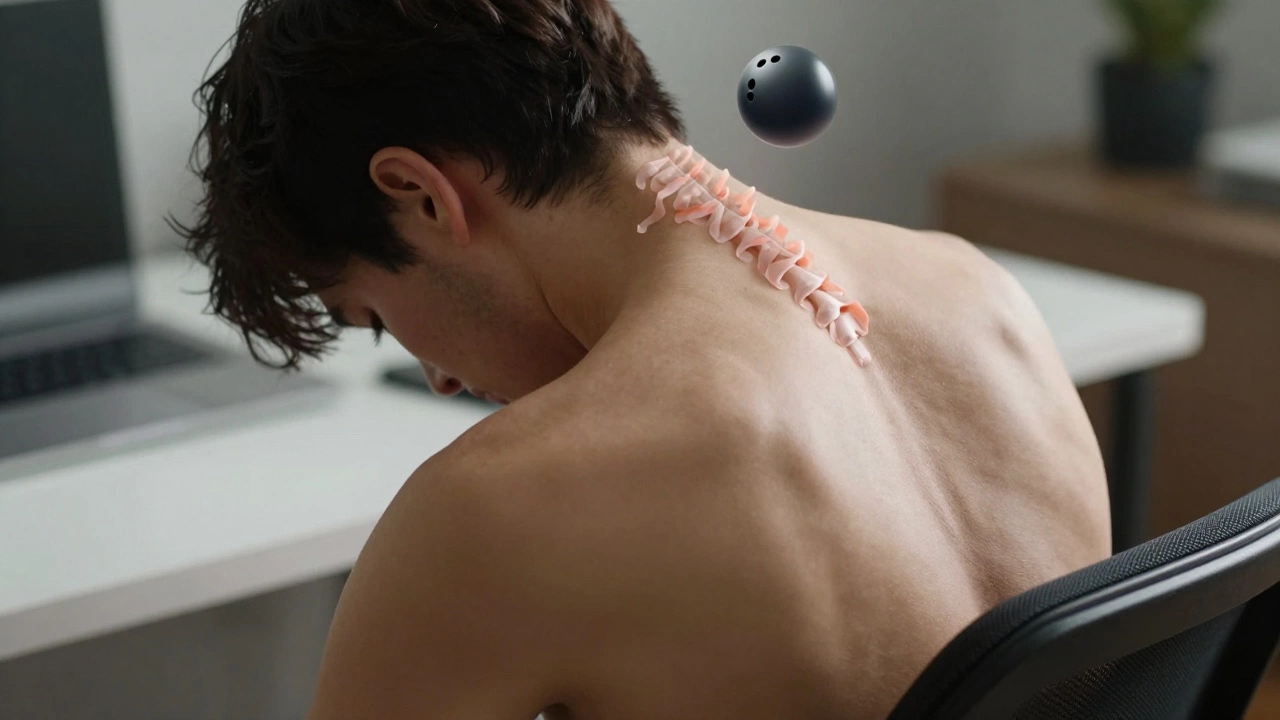
To understand why correcting posture works, you have to understand what’s happening inside your body. When you slouch, your head moves forward relative to your shoulders. For every inch your head protrudes past your ears, the effective weight on your neck increases by about 10 pounds. That’s like carrying a bowling ball on your forehead. Over time, your cervical spine (neck) and thoracic spine (upper back) adapt to this load.
This adaptation is called muscle memory. Your postural muscles, specifically the deep neck flexors and the rhomboids between your shoulder blades, become lengthened and weak. Meanwhile, the chest muscles (pectorals) become tight and shortened because they’re constantly pulling your shoulders forward. This imbalance is often referred to as Upper Crossed Syndrome.
The good news? Muscles are dynamic tissue. Unlike bone structure, which is largely set after puberty, muscle strength and flexibility can be changed at any age. By strengthening the weak muscles and stretching the tight ones, you retrain your nervous system to recognize upright alignment as the default position. This process is known as neuromuscular re-education.
Why Willpower Fails Without the Right Chair
Here is the hard truth: sitting perfectly straight in a flat, unsupportive chair is exhausting. Within minutes, your core muscles fatigue. Once they tire out, your brain subconsciously shifts your weight to save energy. This usually means slumping into the seat or leaning forward onto your elbows. This is why people who try to "just sit better" often fail within a week.
This is where your office chair becomes a critical tool, not just furniture. A proper ergonomic chair acts as an external exoskeleton for your spine. It takes the pressure off your muscles so they don’t have to work overtime to keep you upright. Think of it this way: if you’re trying to build a house, you need a solid foundation. Your spine is the house; your chair is the foundation.
Without adequate support, you are fighting physics. With it, you are working with physics. The goal isn’t to force yourself into a rigid military stance, but to create an environment where good posture requires less effort than bad posture.
Key Features of a Posture-Correcting Chair
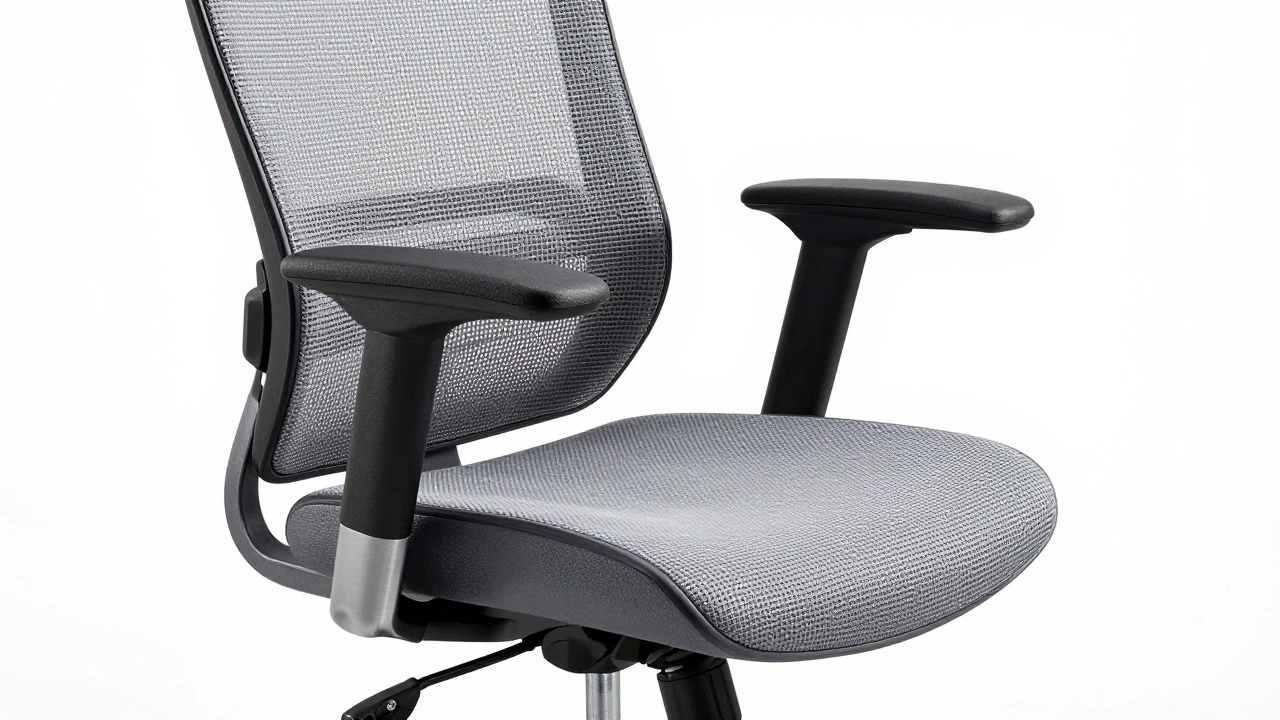
If you are looking to upgrade your setup to help correct your slouching, you don’t need the most expensive brand name. You need specific mechanical features. Here is what actually matters:
- Lumbar Support: This is non-negotiable. Your lower back has a natural inward curve (lordosis). A chair must push against this curve to prevent it from flattening out. Look for adjustable lumbar support that goes up and down, not just in and out. This ensures the support hits your actual waistline, not your ribs or hips.
- Seat Depth: Many people suffer from "edge sitting," where they slide forward because the seat is too deep. This cuts off circulation to your legs and forces your pelvis to tilt backward, causing slouching. You should be able to sit back fully with your knees bent at 90 degrees, leaving about two fingers' width between the edge of the seat and the back of your knees.
- Armrests: Adjustable armrests allow you to rest your arms at a height that keeps your shoulders relaxed. If your armrests are too high, you’ll hike your shoulders up. Too low, and you’ll slump your torso down to reach them. Properly aligned armrests take the weight off your upper back.
- Recline Tension: A static upright position is actually bad for your discs. A slight recline (about 100-110 degrees) distributes pressure evenly across your spine. Look for a chair with adjustable recline tension so you can lean back slightly without feeling like you’re tipping over.
| Chair Type | Lumbar Support | Adjustability | Posture Impact |
|---|---|---|---|
| Standard Dining Chair | None | Low | Negative: Forces slouching |
| Gaming Chair | Built-in (Fixed) | Medium | Mixed: Good for some, restrictive for others |
| Ergonomic Mesh Chair | Adjustable | High | Positive: Promotes active sitting |
| Kneeling Chair | Minimal | Low | Mixed: Forces upright but causes knee strain |
Immediate Fixes: What to Do Today
You don’t need to wait for a new chair to arrive to start improving your posture. There are simple adjustments you can make right now to reduce the strain on your spine.
- The Towel Trick: Roll up a small towel and place it behind your lower back. This creates instant lumbar support. Adjust the thickness until you feel your spine being gently pushed forward. This prevents the "C-shape" slouch.
- Feet Flat on the Floor: If your feet dangle, your pelvis tilts backward, forcing your lower back to round. Use a box, a stack of books, or a footrest to elevate your feet so your thighs are parallel to the floor.
- Screen Height: If your monitor is too low, you will crane your neck down. Raise your laptop or monitor so the top third of the screen is at eye level. This keeps your head aligned over your shoulders.
- The 30-Minute Rule: No posture is healthy if held statically for too long. Set a timer for every 30 minutes. Stand up, stretch, or walk around for one minute. This resets your muscle tension and improves blood flow to your spinal discs.
Strengthening Your Posture Outside the Chair
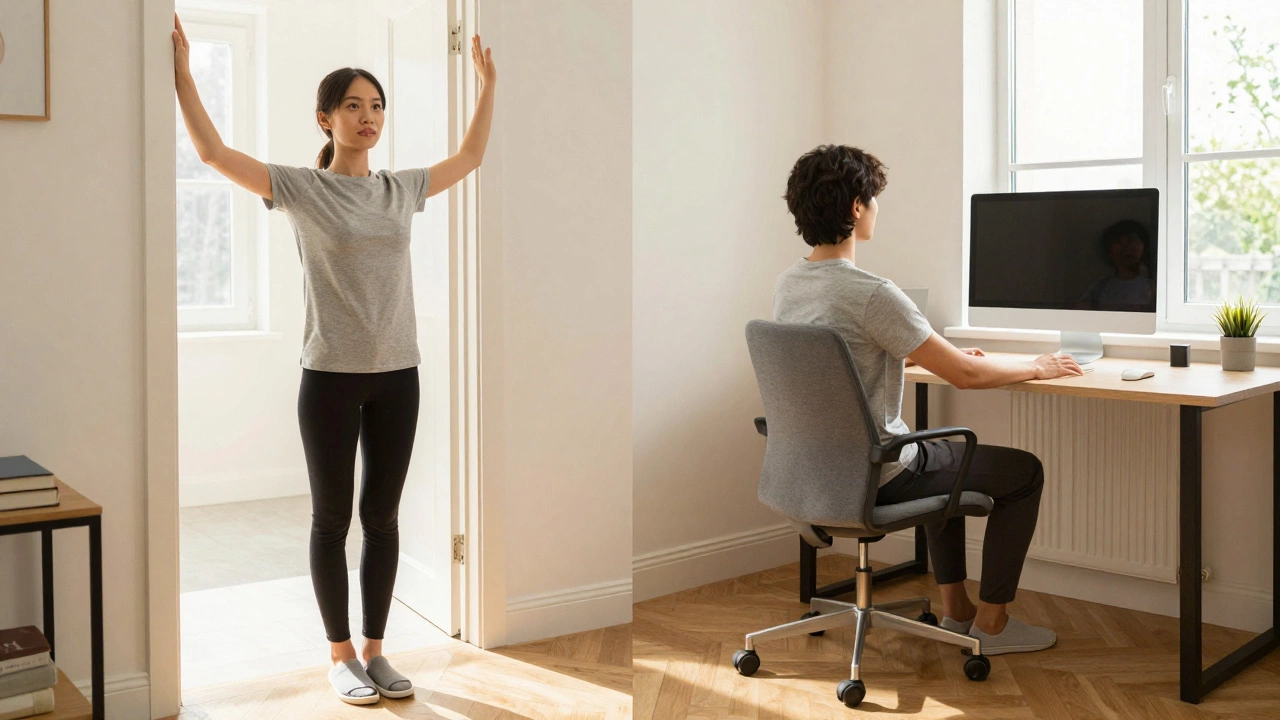
Your chair supports you, but your muscles hold you. To make lasting changes, you need to strengthen the posterior chain-the muscles on the back of your body. Here are three simple exercises you can do at home or even near your desk.
Chin Tucks: Sit or stand tall. Gently pull your chin straight back, creating a "double chin" effect. Hold for five seconds. Repeat 10 times. This strengthens the deep neck flexors and counters forward head posture.
Wall Angels: Stand with your back against a wall. Press your lower back, upper back, and head against the wall. Raise your arms to form a "W" shape, keeping your elbows and wrists touching the wall. Slide your arms up and down slowly. This opens up the chest and strengthens the upper back.
Doorway Chest Stretch: Place your forearms on either side of a doorframe. Step forward gently until you feel a stretch in your chest. Hold for 30 seconds. Tight chest muscles are a major culprit in slouching; stretching them allows your shoulders to roll back naturally.
Common Mistakes to Avoid
As you work on correcting your posture, watch out for these common pitfalls.
Over-Correction: Don’t force your shoulders back so hard that you arch your lower back excessively. This can lead to compression in the lumbar spine. Aim for a neutral spine, where your ears, shoulders, and hips align vertically.
Igoring Hip Flexors: Sitting for long periods tightens your hip flexors. Tight hips pull your pelvis forward, which can cause an exaggerated arch in your lower back (swayback) or a rounded lower back depending on your muscle balance. Include lunges and hip stretches in your routine.
Buying the Wrong Size: An ergonomic chair is only ergonomic if it fits your body. If you are very tall or very short, standard adjustments might not be enough. Look for chairs with extended range adjustments or consider custom cushions.
When to See a Professional
While most slouching is postural and reversible, some cases involve structural issues. If you experience numbness, tingling, or sharp pain in your arms or legs, stop self-treating and see a doctor. These could be signs of nerve compression or disc herniation.
Additionally, if you have been diagnosed with scoliosis or other spinal conditions, consult a physical therapist before making significant changes to your seating setup. They can provide personalized advice based on your specific anatomy.
How long does it take to correct slouching posture?
It varies by individual, but most people notice improvements within 2 to 4 weeks of consistent effort. Significant changes in muscle strength and habit formation typically take 3 to 6 months. Consistency is key; doing exercises once a week won’t yield results.
Do posture corrector braces work?
Posture corrector braces can provide temporary awareness and relief, but they are not a long-term solution. Relying on them can weaken your postural muscles further because the brace does the work for you. They should only be used for short periods under professional guidance.
Is it bad to sit upright all day?
Yes, sitting in any single position for too long is harmful. Even perfect posture creates uneven pressure on your spinal discs. The best posture is your next posture. Change positions frequently, stand up, and move around to keep your joints lubricated and muscles active.
Can I fix my posture without a new chair?
You can make significant progress without a new chair by using modifications like lumbar rolls, footrests, and monitor stands. However, a properly adjusted ergonomic chair makes the process much easier and more sustainable by providing built-in support.
What is the best sitting angle for posture?
A slight recline of 100 to 110 degrees is generally considered optimal. This position reduces pressure on the lumbar discs compared to a strict 90-degree upright angle. Ensure your feet remain flat on the floor or a footrest to maintain stability.